
USFans Review: Is the Shopping-Agent Process a Good Fit for Your Order?
USFans is worth assessing as a sequence of decisions, not simply as a place to click Buy. Its published shopping-agent instructions describe product purchasing and international parcel dispatch as separate stages. That distinction changes how you judge convenience, cost and the amount of checking you need to do yourself.
Our assessment is that this process is a better fit for someone willing to manage those stages than for someone expecting one immediately settled delivered price. The ability to review an item before arranging onward shipping can be useful, but it is not the same as a physical product test. This review examines the documented process and its trade-offs; it does not give a purchase-performance score based on an order we placed.
If your immediate question concerns a collection of product links rather than the service, use the USFans spreadsheet review. For comparing individual customer accounts, the separate USFans reviews guide explains how to avoid counting repeated reports as independent experiences.
Cost clarity depends on keeping the stages separate
USFans' first-time shopping-agent instructions describe an initial payment for the product and domestic shipping in China, followed by a parcel submission and international shipping payment after warehousing. They also recommend estimating international shipping before ordering. Treat that explanation as a reason to plan the whole purchase, not as a quotation for a particular destination.
The practical advantage is that product selection and onward shipment can be considered separately. The disadvantage is that the attractive product figure is not, by itself, enough to decide whether the complete purchase fits your budget.
Before paying, identify which amount you are looking at and what it includes. Reserve room in your decision for the later parcel charge rather than treating it as an optional extra. The payment guide separates transaction stages, while the shipping guide covers the information needed for a meaningful parcel comparison.
Combining products is not automatically a saving. A combined parcel can differ in packed size, weight and available services. Compare actual available options before calling a larger basket better value; do not add an unwanted item solely to make an assumed shipping discount work.
Warehouse inspection is useful, but narrower than a product test
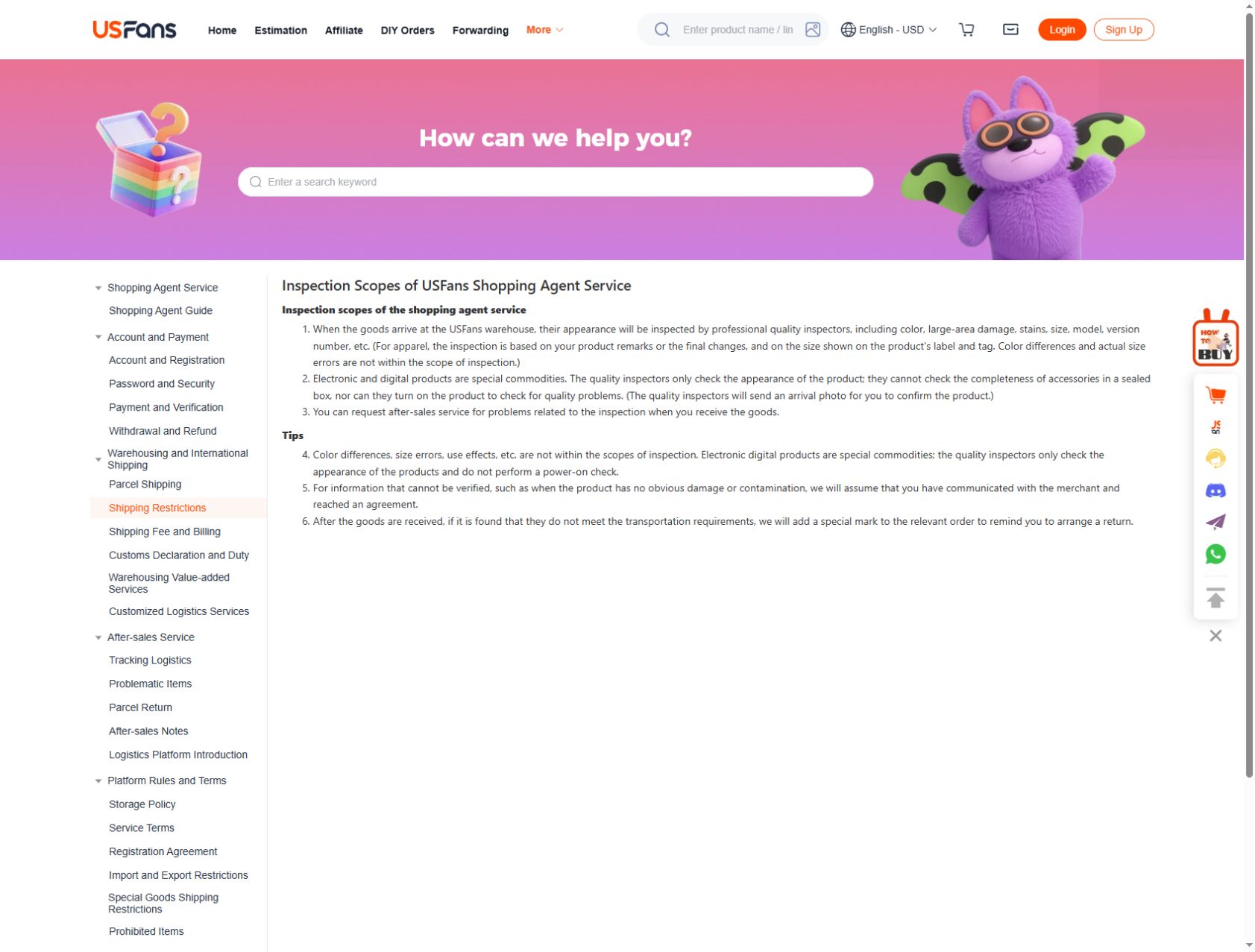
The published inspection scope describes checks for visible condition and identifying details. For clothing, label size is not the same as a measurement of the garment. For electronics, the described inspection is appearance-based rather than a power-on test; sealed contents are also limited. These distinctions matter more than the general phrase “quality checked.”
A visible mismatch may be something you can notice before dispatch. Comfort after a day's wear, durability after washing and electronic performance require different evidence. Do not interpret an arrival photograph as proof of those properties.
For a clothing purchase, decide which question could change your choice. If it is garment length, a readable size label alone will not answer it. The QC guide helps you choose a specific observation instead of requesting more photographs without knowing what they need to show.
An example: selecting a hoodie for regular use
Suppose you want a hoodie to wear under a jacket. The candidate's appearance is only the starting point. Your decision might depend on body length, sleeve fit and whether the neckline works with the layers you already own.
This is a candidate to inspect, not a garment tested for this review. Keep your chosen option attached to the listing, then compare the relevant measurements with clothing that fits you. A label or visible branding does not establish fabric composition or authenticity.
The hoodies and sweaters guide develops those fit questions. If the necessary detail is still unclear, decide whether to obtain it before moving the order to the next stage. Continuing because a photograph looks appealing does not resolve the original uncertainty.
Convenience comes with more decisions to manage
A staged process can give you time to inspect information between purchasing and dispatch. It also gives you more events to monitor: the selected item, its warehouse status, the parcel you submit and the payment for that parcel. Confusing those events can make a normal status difference look like a missing order.
Keep product and parcel references separate in your own records. When checking progress, ask whether you are looking at the seller-to-warehouse movement or the later international shipment. The order-status guide and tracking guide address those different questions.
This is a genuine suitability trade-off. Someone who wants to compare options carefully may accept the extra administration. Someone who needs a simple, fixed arrival commitment should resolve the relevant shipping details before ordering rather than relying on a general impression of speed.
Support quality cannot be reduced to a contact button
A visible support channel tells you where a question can be sent, not how a particular dispute will end. Assess a reply by whether it addresses the actual issue, identifies the affected item or parcel and explains the next action clearly.
For example, a useful answer to a variant mismatch should discuss that variant, rather than merely repeat that the order is processing. A proposed remedy is also different from a completed remedy. Retain the relevant correspondence without publishing personal account or payment information.
Use the support guide to formulate a precise request and the returns guide when deciding what to ask about an unwanted or mismatched item. Check the terms applicable to that case; an anecdote about somebody else's return is not a promise about yours.
Overall assessment
The strongest reason to consider this workflow is the separation between selecting goods and deciding on their onward shipment. The main limitation is that you must understand what each stage does—and does not—establish. A product price is not a complete parcel cost, a label check is not a fit test, and a dispatch event is not delivery.
Proceed only when those distinctions are acceptable for your purchase and the unresolved details would not overturn your decision. If a critical question concerns shipping cost, product suitability or a proposed remedy, answer that question before committing to the next step. The USFans spreadsheet guide brings the full sequence together.
Quick questions
Does a good spreadsheet make the service a good choice?
It can make discovery easier. It cannot determine the eventual parcel charge or establish the quality of every linked item. Evaluate the collection and the transaction separately.
Does inspection remove the need to check measurements?
No. The published clothing inspection scope distinguishes the label from actual dimensions. If a measurement matters to your choice, obtain information that addresses that measurement.
Is this a recommendation to place a large first order?
No. Decide your commitment from the costs and uncertainties you can evaluate, not from the number of attractive links you have collected. Adding more items does not make missing information more reliable.