
USFans Shipping Calculator: Make an Estimate You Can Compare
A useful USFans shipping calculator result needs a clear label: what parcel did you ask it to price? Keep that answer beside the amount. If you cannot reconstruct the destination, contents and packed measurements, you cannot tell whether a later figure represents a price change or a different shipment.
Use an early estimate to explore a purchase, then replace assumptions with measurements as the items reach the warehouse. An attractive estimate should not become a fixed budget merely because you saved it first.
Prepare the inputs before comparing the outputs
Start with the destination country and any delivery-area information requested. Add the correct content characteristics and the weight and dimensions required by the estimator. Do not select a convenient item type that misdescribes the parcel just to reveal a cheaper option.
Separate measured values from guesses in your own notes. A product listing's garment measurements are not the external dimensions of a shipping box. Likewise, the combined weight of unwrapped products does not establish the weight after packing.
If you are still choosing items, keep the exact selected variations in your USFans spreadsheet. A change of size, quantity or product can require another estimate even when the main listing image stays the same.
Understand which weight the route prices
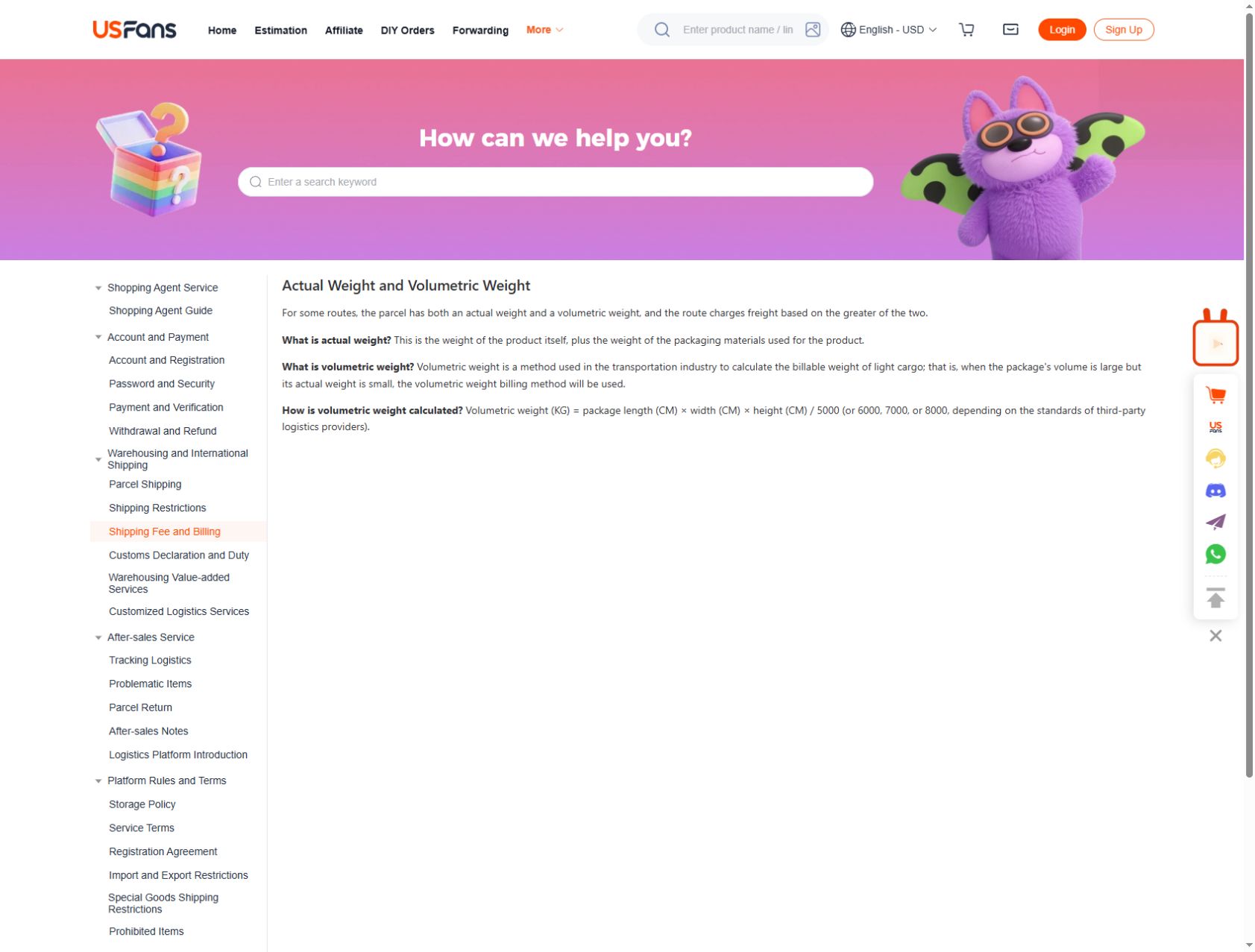
The USFans weight explanation checked on September 30, 2026 includes packaging in actual weight. Some routes use the greater of that weight and volumetric weight, calculated from the parcel dimensions using the logistics provider's divisor. This is why applying one universal per-kilogram number is unreliable.
Consult the rule for the route being compared, including its chargeable increments or rounding where shown. The shipping guide illustrates the volume calculation. A hand calculation can help you understand a result; it does not replace the selected service's quote.
For a hypothetical 45 × 32 × 24 cm parcel weighing 4.1 kg after packing, a divisor of 6,000 gives 5.76 kg volumetric weight. A greater-of-two rule would therefore start with 5.76 kg before any route-specific rounding. With a divisor of 5,000, the same dimensions instead give 6.912 kg. These are calculation examples, not measured USFans parcels or country quotations; use only the divisor attached to the actual service.
Change one assumption at a time
Suppose you want to know whether adding a jacket changes the parcel budget. Retain the initial parcel's inputs, then create a second estimate with the jacket and revised packing assumptions. Do not also change the destination or service without noting it: you would lose the ability to identify what caused the difference.
For uncertain packing dimensions, try clearly labelled alternative measurements rather than quietly treating the smallest possible box as certain. These alternatives show sensitivity to assumptions, not a guaranteed upper or lower charge. Taxes, services or surcharges outside the calculation can still change the amount you eventually pay.
Keep the comparison short:
| Estimate | Record beside the amount |
|---|---|
| Initial selection | Items, quantities, guessed packing and quotation date |
| Warehouse measurements | Actual available measurements and remaining assumptions |
| Revised configuration | The specific item, packing or service change |
| Payment decision | Current amount, included charges and chosen route |
When the estimate changes, look for an explanation
Compare the old and new input records before concluding that the price alone changed. Check weight, dimensions, location, item characteristics, service and selected extras. Also check the currency and whether a discount was applied to only one figure.
If the displayed breakdown still does not explain the difference, ask support a focused question with the two records. Share order identifiers through the account's support channel rather than in a public screenshot. Do not make another payment simply to test whether the earlier payment was recognised.
No result is not the same as free shipping
An empty list or unavailable service may require corrected input, different legitimate packing or confirmation that the contents and destination are supported. It does not prove that every route is permanently unavailable, nor does it justify choosing a false category.
Record the error wording and the inputs that produced it. The warehouse guide is the next step if you need confirmed parcel measurements; the delivery-time guide helps compare the time boundaries of the services that are actually offered.
Examine the item before adding it to the estimate
A calculator does not decide whether a saved product is the variation you intended to buy. Inspect the listing first, retain the selected option and then ask what adding it means for the whole parcel.
Check the jacket details on OG
Use the spreadsheet links guide to keep that candidate identifiable if the listing has several options.
Questions about shipping estimates
Is the calculator amount my final landed cost?
Only treat it as covering the charges explicitly included. Check product payment, domestic movement, international transport, optional services and destination charges separately where they apply. An estimate for one stage is not evidence that the other stages cost nothing.
Can I calculate without dimensions?
Follow the inputs required by the specific estimator, but recognise what remains unknown. If the chosen service can bill by volume, a weight-only planning figure cannot establish the packed charge.
Should I save screenshots of the estimate?
A private dated record can help explain changes. Include the relevant inputs and breakdown, but crop or redact names, delivery addresses, account details and parcel identifiers before sharing it outside your account. Do not present an old estimate as a current offer to another buyer.